Informe sobre Cooperación para la Justicia Global 2026: “Sembrando claves y propuestas de fuga para la descolonización de la Cooperación”

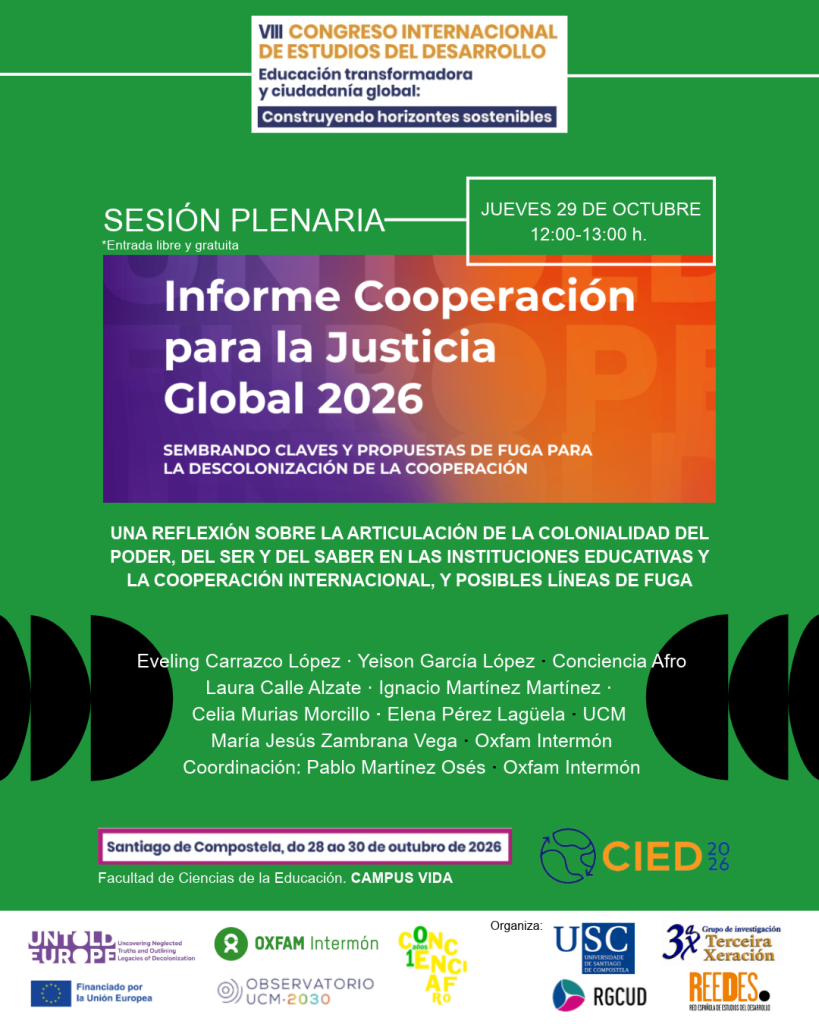
El próximo 29 de octubre, en el marco del VIII Congreso Internacional de Estudios del Desarrollo, Oxfam Intermón presentará el informe “Sembrar claves y propuestas de fuga: hacia la descolonización de la cooperación”, resultado de un proceso de investigación colectiva desarrollado junto a personas investigadoras, organizaciones antirracistas y colectivos decoloniales.

El informe reúne reflexiones y propuestas sobre cuestiones clave como la violencia epistémica, la exclusión racial, el racismo ambiental y las múltiples formas en que las lógicas coloniales siguen presentes en la cooperación internacional. Al mismo tiempo, plantea caminos alternativos para avanzar hacia modelos más justos, inclusivos y transformadores.

Programa de la presentación

Informe sobre Cooperación para la Justicia Global 2026: Sembrando claves y propuestas de fuga: hacia la descolonización de la cooperación

Participan:

  • Eveling Carrazco López (colaboradora de Espacio Afro)
  • Yeison García López (Espacio Afro)
  • María Jesús Zambrana Vega (Oxfam Intermón)
  • Laura Calle Alzate (Universidad Complutense de Madrid)
  • Elena Pérez Lagüela (Universidad Complutense de Madrid)
  • Celia Murias Morcillo (Universidad Complutense de Madrid)
  • Ignacio Martínez Martínez (Universidad Complutense de Madrid)
  • Pablo Martínez Osés (Oxfam Intermón)

Información práctica

📅 Fecha: 29 de octubre de 2026
🕛 Hora: 12:00 – 13:00 h
📍 Lugar: Facultad de Ciencias de la Educación, Campus Vida, Universidad de Santiago de Compostela (USC)
C/ Prof. Vicente Fráiz Andón, s/n, 15782 Santiago de Compostela

Importante: La Facultad de Ciencias de la Educación de la USC dispone de dos campus. El congreso se celebrará en el campus situado en la zona sur de la ciudad (Campus Vida).

Te invitamos a acompañarnos en este espacio de diálogo y reflexión colectiva para repensar la cooperación internacional desde perspectivas antirracistas, decoloniales y orientadas a la justicia global.

Sobre el informe

El informe consta de una introducción y cuatro capítulos.

El Capítulo II, elaborado por el Observatorio UCM 2030 de la Universidad Complutense de Madrid (UCM), ofrece un análisis en profundidad de la universidad como institución colonial, examinando las normas y prácticas que perpetúan la exclusión racial estructural.

El Capítulo III, elaborado por Conciencia Afro, desarrolla una crítica a la cooperación al desarrollo y a la «colonialidad del saber» que esta reproduce.

El Capítulo IV, también elaborado por Conciencia Afro, explora diferentes horizontes de justicia compensatoria y restaurativa, abordando tanto las deudas del pasado como las del presente. Asimismo, analiza la continuidad de violencias y  las deudas que las naciones coloniales e imperiales deben reparar.

El Capítulo V, elaborado por Oxfam Intermón, propone redefinir el marco de la financiación para el desarrollo. Más allá del enfoque limitado de la Ayuda Oficial al Desarrollo (AOD), plantea reimaginar y redefinir este marco como la base de un fondo global destinado a la reparación y a la convivencia global.

Presentation day for Untold Discussion Paper – “TEN QUESTIONS AND ANSWERS ON COLONIAL AND RACIST NARRATIVES ABOUT MIGRATION”

Please note: The event will be held in English only

This event is part of the activities of the UNTOLD led by Oxfam Intermón and ECPS with collaborators from different countries of the European Union. 

On Tuesday, October 27  we will present and talk about the discussion paper “DECALOGUE OF QUESTIONS AND ANSWERS ON COLONIAL AND RACIST NARRATIVES AROUND MIGRATION” that arises from the conference “Reflections and dialogues on colonial and racist narratives on migration. From perceptions and social listening to a decolonial gaze” carried out by the UNTOLD project on 15 April 2026 at the National Museum of Anthropology in Madrid, and the knowledge and studies on narratives and perception of migrations carried out by Oxfam Intermón and the Oxfam confederation since 2012. 

This discussion paper tries to respond from a simple and pedagogical approach to some of the most relevant questions about migration narratives from a decolonial perspective, such as: 

  • Why do anti-immigration narratives triumph? 
  • How are anti-immigration narratives translated into the media and social media? 
  • What legal and institutional response is there to racist anti-immigration narratives?  
  • What construction of migratory narratives can be made from the self-determination and political agenda of the migrants themselves? 

It also tries to make a brief review of the recommendations that emerged at the Madrid conference to confront colonial and racist narratives, from the different dimensions that would need to be faced: the decolonial dimension, the political and legal, legal, media and cultural dimensions, self-determination and the political agenda of migrants themselves and Global Justice. 

Agenda

Half day: From 08:30 to 12:30 hours 

08:30 – 09:00 – Welcome coffee, networking, and reception of conference attendees  

09:00 a.m. – Opening and welcome: Marita Zambrana, Project Manager UNTOLD Europe and Azize Sargin, Director for External Relations European Centre for Populism Studies

09:15 – 11:00 – FIRST PANEL: Debate on the discussion paper. “Decalogue of Questions and Answers on Colonial and Racist Narratives Around Migration” 

  • Dr. Reda Mahajar, Sociology Department, University of Antwerp 
  • Tine Claus, Director of Flemish Refugee Action 
  • Lilana Keith, Senior Advocacy Officer on Labour Rights and Labour Migration, PICUM
  • Discussant: Daniele Manno, MEDEX MUSEUM

Panel Moderator: César Santamaria, Oxfam Intermón specialist in migration narratives

11:00 – 11:30 – Coffee break and networking 

11:30 – 12:30 – SECOND PANEL: Recommendations. What should the European Union do that it is not doing to confront colonial and racist narratives? 

  • Dr.  Carmine Conte, Senior Legal Policy Analyst, Migration Policy Group, Brussels
  • Colette Meffire, Mosaico – Action for Refugees
  • Shada Islam, journalist
  • Discussant: Tola Ositelu, PhD Fellow, VUB University Brussels 

Panel Moderator: Nick van der Steenhoven, Oxfam Migration Coordinator Europe

Where?

Résidence Palace – International Press Centre – Brussels 

Rue de la Loi 155 – 1040 Bruxelles 

Malbeek Room 

ONLY attendees will receive the discussion paper prior to the event: please REGISTER

REGISTRATION FORM

Decolonising cooperation: discomforts, learning, and horizons for transformation

On May 21, the webinar “Decolonizing cooperation: discomforts, ruptures and learning” took place as part of the UNTOLD Europe project. The event brought together diverse voices from institutions, academia, and social movements to critically rethink international cooperation in a global context marked by deep inequalities. 

A starting point: global crisis and the need to rethink cooperation 

The session opened with a reflection on today’s global context: a world of growing inequality, where wealth and political power are increasingly concentrated while international cooperation and the multilateral system are under pressure.  

“What we propose is to collectively build a transformed cooperation with a rebalancing of power and the political courage to change the system.”


In this context, the urgency not to abandon cooperation, but to fundamentally transform it, towards more just, solidarity-based models aligned with global justice. 

A collective reflection process from the Global South 

The report presented during the event developed by the “ephemeral team” is the result of four years of collective work with feminist activists and organizations from the Global South.  

This process identified key structural critiques of the current cooperation system: 

  • The persistence of power relations rooted in colonial histories 
  • The imposition of agendas from the Global North 
  • Bureaucratic barriers and restrictive funding conditions (“bureau-repression”) 
  • The depoliticization of social struggles when adapted to funding logics  

“This model of cooperation carries a colonial legacy that structures economic dependency and imposes agendas.”


Rather than offering definitive answers, the report serves as a point of inflection, emphasising the importance of embracing discomfort as a necessary condition for transformation. 

From diagnosis to proposals: repair as a horizon 

One of the main shared conclusions emerging from the discussion was the need to reframe cooperation through the lens of historical repair. 

This perspective calls for: 

  • Recognizing current inequalities as the result of colonial processes 
  • Building more horizontal, trust-based partnerships 
  • Redistributing decision-making power 
  • Valuing and strengthening knowledge from the Global South  


“The horizon is the action of repair a historical debt.”


At the same time, important questions remain open: What does “repair” actually mean? Who defines it? How can it avoid becoming another form of colonial practice? 

These questions highlight the need to further clarify and operationalize this concept. 

Institutional tensions and challenges for change 

Speakers from institutional contexts shared both progress and limitations in transforming cooperation systems: 

  • Political and structural resistance persists in addressing Europe’s historical responsibility 
  • Legal and administrative frameworks hinder deeper transformations in funding and power relations 
  • There is an ongoing tension between building truly shared agendas and responding to domestic political pressures in donor countries  

Despite these challenges, promising approaches were highlighted, including network-based collaboration, more flexible funding mechanisms, and the integration of feminist and decolonial perspectives into public policy. 

Opening questions to drive transformation 

The closing interventions stressed the importance of avoiding simplistic answers. 

Key reflections included: 

  • Decolonisation is not only an individual process, but a structural one 
  • Cooperation is embedded in global power systems 
  • Repair should focus on preventing the reproduction of inequalities and violence  

Ultimately, the event reaffirmed the need for spaces of dialogue that are both critical and uncomfortable, capable of questioning existing systems and collectively imagining alternatives. 

 Main Conclusions 

  • Discomfort is necessary to transform a cooperation system shaped by colonial relationships. 
  • Cooperation must be rethought through the lens of historical repair, not as aid but as a response to an extractive system. 
  • Decolonization cannot remain at the level of discourse; it must translate into real changes in power and funding. 
  • Transforming cooperation requires embracing tensions and redefining it as repair, without abandoning it. 
  • There is a gap between discourse and practice, and a structural tension that is difficult to resolve within the system itself. 
  • Without historical recognition and conceptual clarity, decolonisation risks being superficial or even harmful. 
  • Decolonization requires deep structural changes and a political positioning in relation to power. So, ¿Can we decolonize cooperation without questioning the colonial structures? The answer is no. 
Socialización de la Sistematización de aprendizajes del Equipo Efímero de Decolonialidad de Oxfam. (1080 x 1080 px) (600 x 800 px)

reflexión de la decolonialidad feminista

Este documento es la sistematización de aprendizajes de un proceso de cuatro años, en el que un grupo interno de feministas de Oxfam en América Latina y el Caribe —el equipo efímero— ha construido y tejido saberes, reflexiones y sabidurías en torno a la relación entre cooperación y decolonialidad. A lo largo de este camino se desarrollaron diversas acciones: webinarios, documentales, fanzines, encuentros presenciales, podcasts, diálogos políticos y una Investigación Acción Participativa (IAP).

Estos espacios implicaron una conversación profunda tanto con feministas decoloniales de Abya Yala como con personal interno de Oxfam, atravesando incomodidades, dolores y también gozos en el intento de decolonizar la cooperación.

Now Published: The Catalogue of Salt in the Wound, Gold in the Vault

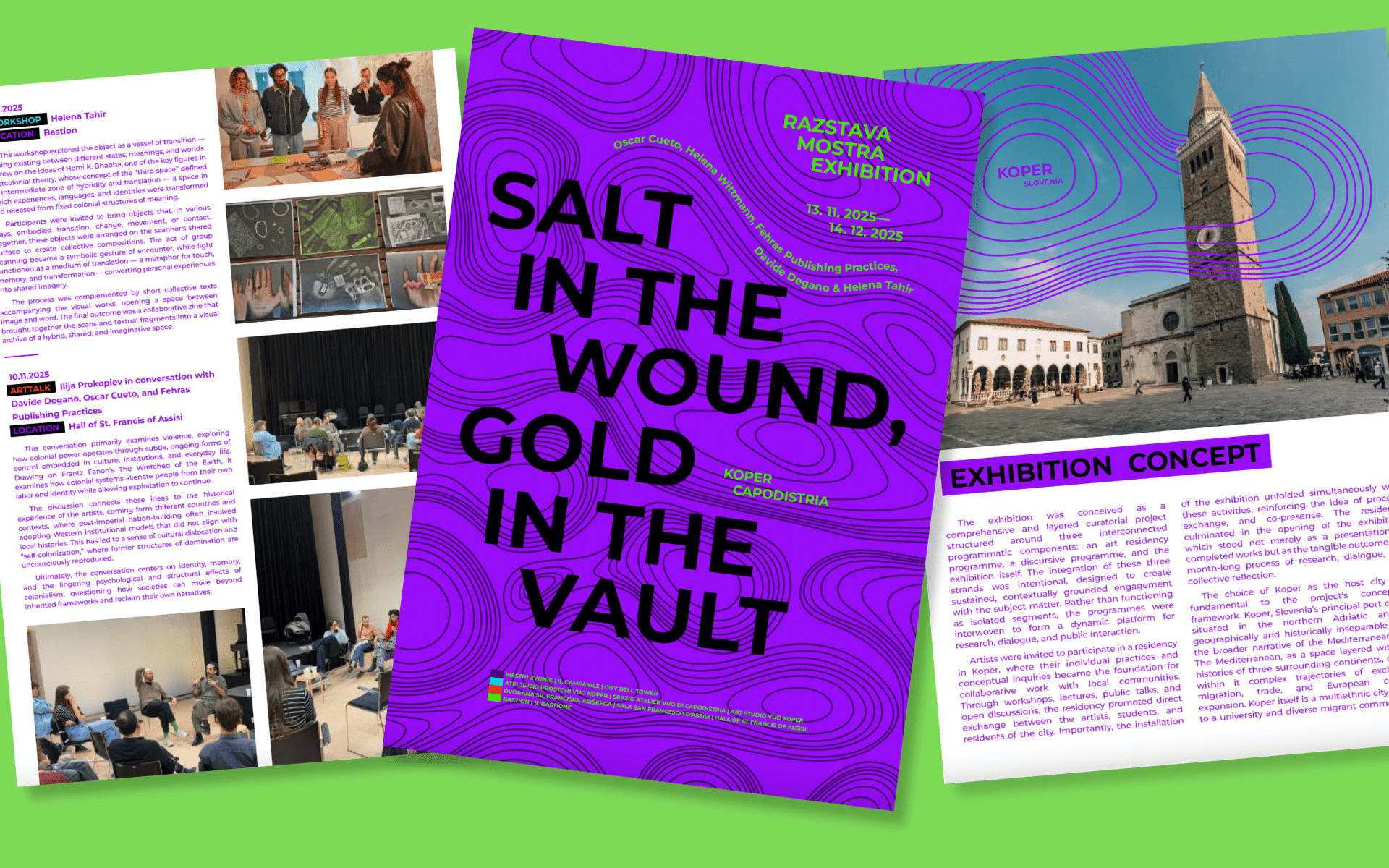
Following the exhibition Salt in the Wound, Gold in the Vault, presented in Koper between 13 November and 14 December 2025, we are pleased to announce the publication of the accompanying catalogue, offering a comprehensive insight into the exhibition and its broader conceptual framework.

The catalogue brings together key elements of the project, including the exhibition concept, detailed presentations of the participating artists and their works, as well as contributions by the curator and collaborators. It also features rich photographic documentation of the exhibition display across its multiple venues, capturing the spatial and experiential dimensions of the project. 

Through these materials, the publication reflects the exhibition’s layered curatorial approach, which combined artistic production, research, and public dialogue. The works of Oscar Cueto, Helena Tahir, Fehras Publishing Practices, Davide Degano, and Helena Wittmann engage with themes of colonial memory, migration, identity, and historical responsibility, approached through anti-racist, feminist, and decolonial perspectives. 

Published in 2026, the catalogue was produced by INNOVATO Ljubljana as part of the UNTOLD Europe project.

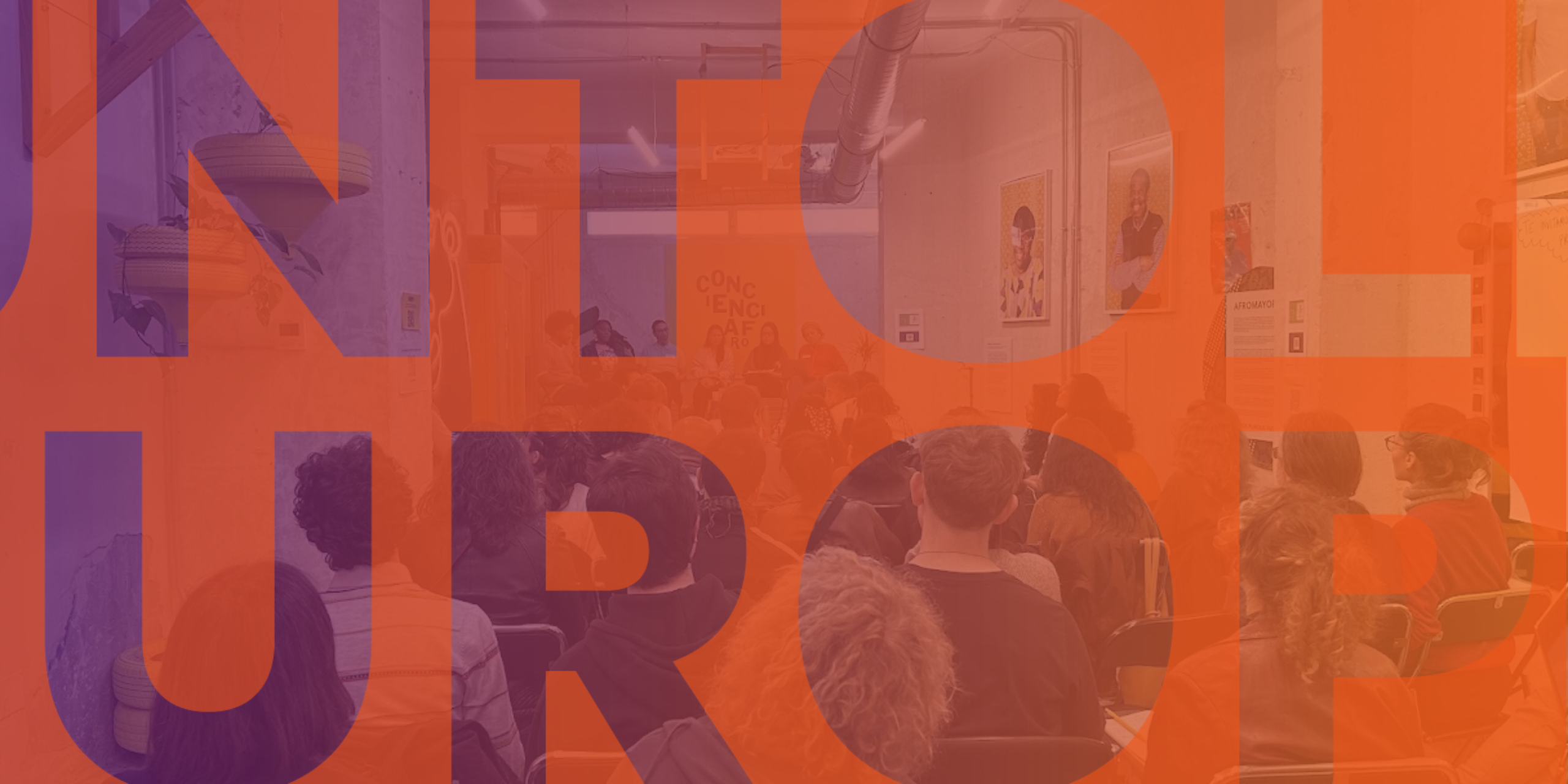
Reflections and dialogues on colonial and racist narratives about migration

FROM PERCEPTIONS AND SOCIAL LISTENING TO A DECOLONIAL PERSPECTIVE

When? – Wednesday, April 15, 2026. From 09:30 hours.

Where? – Auditorium of the National Museum of Anthropology C. de Alfonso XII, 68, Retiro, 28014 Madrid

Why? – This event is part of a series of activities of the UNTOLD Uncovering Neglected Truths and Outlining Legacies of Decolonization project  funded by the European Union and led by Oxfam Intermón with collaborators from different countries of the European Union.

Throughout this day we want to put on the table several dimensions of knowledge and analysis on the question: how are narratives about the migrant population constructed?

The construction of social perceptions of migrants and migratory movements is conditioned by the public narratives and narratives that circulate in the political, media and social space. The way in which the media, institutions, social organizations and digital networks construct and transmit the migratory narrative contributes to shaping a certain idea of the reality that surrounds us, but can we make an analysis of migration without making a process of memory?

To understand contemporary narratives on migration, it is essential to place them in a broader historical and political framework, marked by the legacy of coloniality.

Current representations of migrants, especially those racialized, cannot be separated from historical processes such as European colonization, the transatlantic trafficking of black Africans, and the construction of racial hierarchies that have structured the world order for centuries.

These hierarchies did not disappear with the formal end of colonial empires, but continue to operate through what numerous academic and social analyses have called the coloniality of power: a system that produces and reproduces global inequalities, legitimizing the dehumanization of certain groups.

In this context, migrations become a central element of contemporary narratives where Negrophobia and Islamophobia are not isolated expressions of individual prejudice, but manifestations of a broader system: structural racism, which defines who is considered human, who legitimately belongs to the European space and who is perceived as a threat, a delinquent or illegal.  

Anti-migration narratives have been worryingly integrated into the European public agenda in recent years. This phenomenon has several consequences.

On the one hand, it contributes to generating a social climate of mistrust and rejection towards migrants and refugees, making invisible both their diversity and the multiple contributions they make to host societies.

On the other hand, it hides the structural causes of contemporary migrations, including global inequalities, conflicts, the impact of international economic policies or the persistent consequences of colonial history.

Moreover, these narratives do not operate only in Spain or Europe, but are part of broader dynamics that are reproduced with local particularities in different contexts, such as the United States or other territories of the Global North. In all these spaces, racism functions as a structural system that organizes social, political, and economic relations, producing discourses that legitimize policies of exclusion, control, and securitization of borders.

It is essential to ask who benefits from these narrative frameworks and what interests sustain their reproduction. Anti-migration narratives not only shape social perceptions, but also legitimize certain public policies, reinforce political projects based on fear and exclusion, and divert attention from other structural problems. At the same time, they contribute to normalizing hate speech and questioning fundamental principles of human rights that seemed widely agreed upon. 

Faced with this context, it is essential to promote spaces for critical reflection and dialogue that allow the dominant narratives to be questioned. This involves not only analyzing how social perceptions are constructed, but also identifying the historical, political, and cultural frameworks that sustain them, as well as amplifying the voices and experiences of migrants and racialized people themselves. Only through this process will it be possible to move towards more just, complex and rights-based narratives, capable of contributing to more egalitarian and inclusive societies.

AGENDA

09:30 – 10:00 – Reception of those attending

10:00 – 10:30 – Opening of the conference

Irune Aguirrezabal, member of the Board of Trustees of Oxfam Intermón, Director of the Ibero-American Program on Human Rights, Democracy and Equality of the Organization of American States (OEI)

10:30 – 12:00 – Perceptions on migration. Reflections and dialogue from studies and research.

Participants:

    • Luis Aguado, Associate Director for Spain and European Projects, More in common

    • Paula Cáceres, journalist, head of
      Advocacy at AlgoRace, columnist in various media.

    • César Santamaria, expert in narratives and migrations Oxfam Intermón.

Moderator: Marita Zambrana Vega – Project Manager UNTOLD Europe – Oxfam Intermón

12:00 – 12:30 – Coffee break

12:30 – 14:00 – Legal frameworks, institutional responsibility and response to racism, hate speech and disinformation. Reflections from the legal and public policies.

Participants:

    • Pastora Filigrana, lawyer and director of Action Against Hate

    • Youssef M. Ouled, journalist, co-author of Living Against Racism and coordinator of AlgoRace

    • María Teresa Verdugo, Chair of the Independent Authority for Equal Treatment and Non-Discrimination (AINODI)

    • Ernesto García, coordinator of the Knowledge Unit in the Socio-Economic Justice Division of the Programmes, Citizenship and Policy Advocacy Department at Oxfam Intermón.

Moderator: María José Gascón – Lead Socio-economic Justice at Oxfam Intermón

14:00 – 15:00 – Lunch

15:00 – 16:30 – Narrative frameworks on migration: social networks, media, culture and education.

Participants:

    • Moha Gerehou, anti-racist journalist collaborates in “Todo es mentira” and Aragón TV

    • Line Hougaard Andersen y Leviathan Milan Boham University study “Narratives on migration in the media in pre-election periods” (research for Denmark, the Netherlands and Spain)
    • Andrea Pacheco, curator and researcher of contemporary art of
      Chilean origin. 

Moderator: Jessica Romero – Head of Media and Social Networks  Oxfam Intermón

16:30 – 17:00 – Coffee break

17:00 – 18:30 – Construction of migratory narratives from self-determination and political agency. Reflections and dialogues from civil society

Participants:

    • Gabriel Zapata of Conciencia Afro a cultural proposal, focused on vindicating, celebrating and disseminating the realities and knowledge of the black, African and Afro-descendant community from Spain.

    • Julissa Jauregui, an expert in migration, anti-racist activist linked to different historical processes of the migrant struggle in Spain.

    • Paula Domingo of Asociación ELIN, an  organization focused on justice and the protection of the rights of migrants.

    • Erik Guerrero of Frente Migrante, a space for anti-racist political-cultural thought and action. Formed by migrant citizens in Spain.

Moderator: Rodrigo Barahona – Lead Strategy, knowledge and learning at Oxfam Intermón

RESERVE YOUR PLACE (SPACES ARE LIMITED)

Visual report on the Courageous Conversations on Migration

We have compiled a video showing some of what happened during the days of courageous conversations.

You can watch the video in English here.

You can watch the video in French here.

You can watch the video in Spanish here.

Some of the participants in the video

  • Martha Esperanza Sánchez – Programme Manager Oxfam Central America
  • Okba Mohammad – Syrian Journalist and Baynana Founder
  • Sarah Chander – Equinox Iniative for Racial Justice
  • Seydou Diop – Asnuci, Spokeperson