
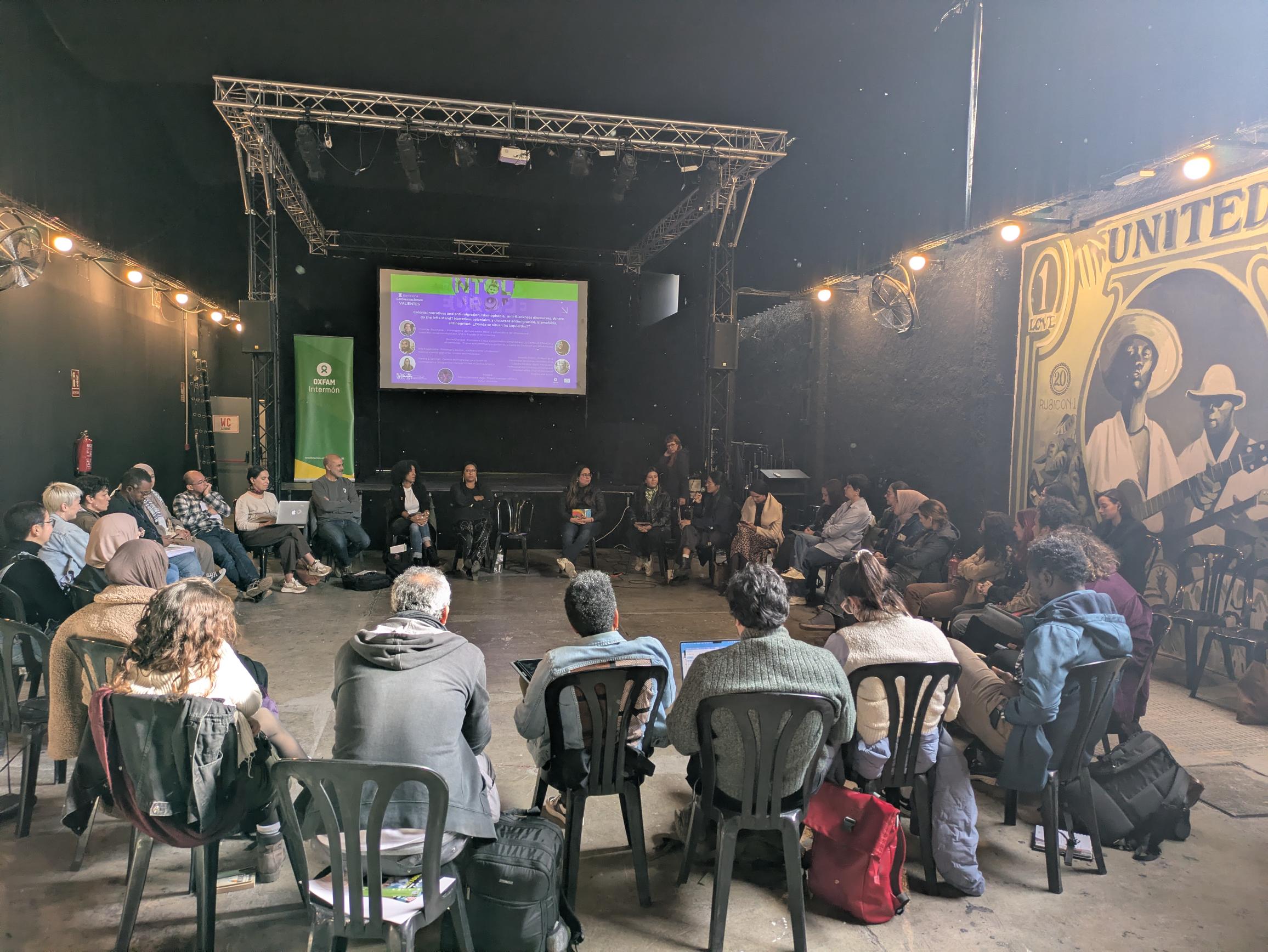
On Tuesday and Wednesday, 11th and 12th November, we held the ‘courageous conversations’ event at Nau Bostik in Barcelona as part of the UNTOLD project, a project funded by the European Commission.
The event, organised by Oxfam Intermón but also attended by various members of the consortium of UNTOLD Project such as ECPS, Equinox and Qualia, addressed different aspects of migration, all of which are deeply interconnected. In the end, more than 70 people of different nationalities and backgorunds, both from the North and from different countries in the Global South, were present to share their different perspectives.
The first conversation addressed the upcoming launch of the EU Mediterranean Pact under the slogan ‘Who wins, who loses?’ In a Mediterranean marked by overlapping crises conflicts, forced displacement, inequalities and climate emergency, we joined activists, journalists, civil society representatives and academics in questioning the EU’s proposal to revitalise Euro-Mediterranean relations. It is not just a question of how the European Union positions itself vis-à-vis its Mediterranean neighbours: what is at stake is the Mediterranean we want to build at a time of rising reactionary politics and growing attacks on multilateralism.
We have some clues, some hints as to where this new Mediterranean pact might be headed, based on what politicians are telling us: energy agenda, educational exchanges, defense agenda, and migration, an emphasis on the private sector agenda, on investment. Cristina Rovira
We note that the Mediterranean remains one of the deadliest migration routes, with more than 32,000 deaths since 2014 and an EU that prioritises approaches based on externalising borders, securitisation and migration containment. We also raised a major alert regarding the renewable energy hub that the EU is proposing for North Africa, which risks reinforcing extractivist logics that displace local communities and perpetuate inequalities, especially in occupied territories. Finally, we were able to share how the closure of spaces for activism and the right to protest is a common trend, especially in the areas of climate justice, migration and pro-Palestinian movements on both sides of the Mediterranean. In response to this, we reaffirm the role of civil society and movements as a counterweight, and the need to build horizontal and decolonial alliances in the region, alliances that are already being built and continue to advance in dialogues such as the Courageous Conversations.
The pact is based on three pillars, the second of which focuses on the economy and aims to ensure sustainability in countries. But the reality is that it seeks cheap resources in Mediterranean countries: water, sun, natural resources, cheap labor…
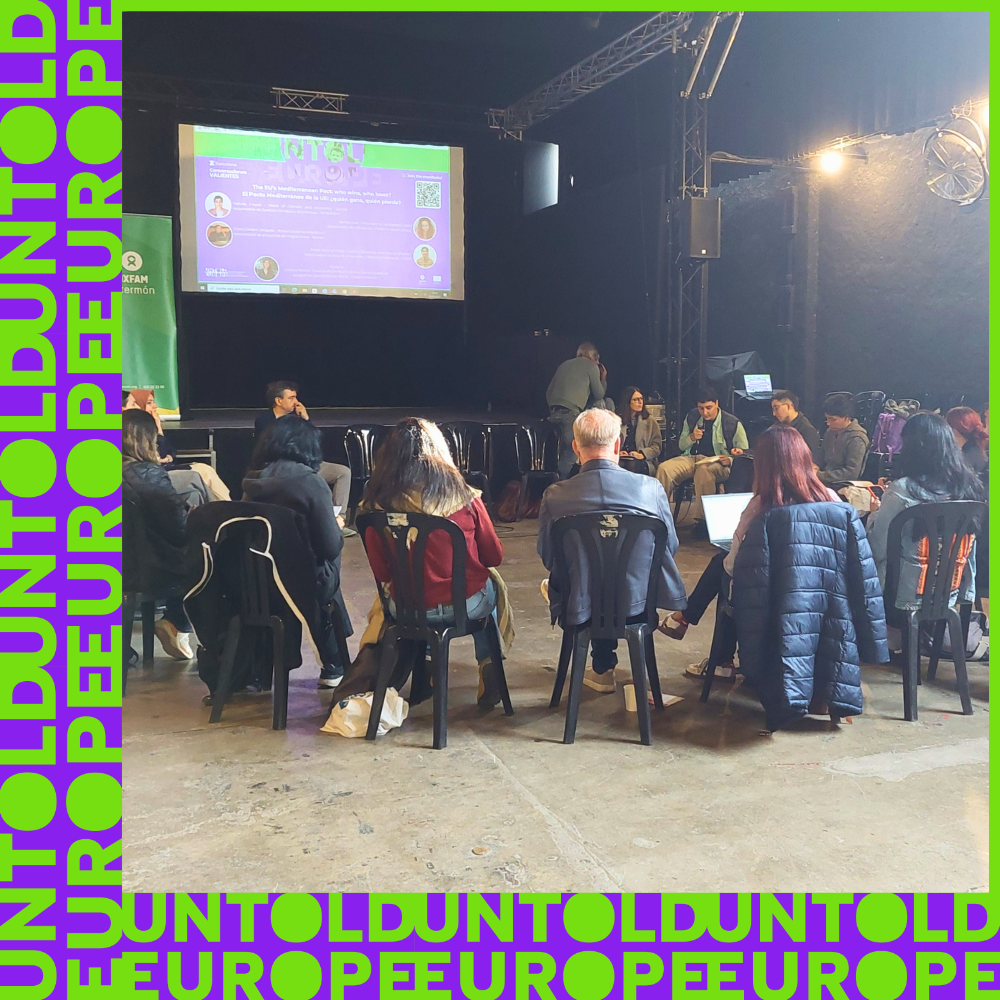
In the second conversation, where they landed on specific immigration policies, they discussed the new deportation regulation which, if approved in its current form, would allow for deportation to a country where the person has only transited and is not even their country of origin. And some headlines were given on the trends that guide this and other decisions: more prisons and less rescue, more racial profiling by police and agencies, more ‘surveillance’ business, or far-right logic becoming normative.
On the subject of regularisation, it was noted that, once the pandemic was over, it was migrants and the far right who were on the streets. And that the ILP for regularisation was the first cordon sanitaire against the far right. However, no party has made it a priority and it has still not been approved, not even by RD (royal decree, a type of law that the Spanish government can enact unilaterally)
Once again, not only the legal framework but also the colonial, racist, classist and exclusionary administrative practices that explain the systematic violation of the right to register that many migrants suffer were denounced.
Finally, an approach was made to the so-called European Pact on Migration and Asylum, which, despite bearing the title of migration and asylum, is a set of regulations that focuses exclusively on border control and asylum procedures. Migration policies must have a broader dimension, recognising rights, integration, access to the labour market, the fight against xenophobia and hate speech, etc. All of this is ignored in the Pact, which focuses solely on the vision of Fortress Europe.
The third conversation addressed colonial narratives and raised several questions, such as where the left stands in this territory and how racial imaginaries are constructed in Spain and Europe, pointing out that, although it is easy to identify the narratives of the right and the far right, it is equally necessary to examine the role of the left. We questioned whether their political projects are truly based on anti-racism and whether they guarantee the presence of racialised people in positions of power. In a context where hate speech, especially Islamophobic discourse, has not disappeared but rather mutated, the importance of analysing the historical roots of racism, linked to the configuration of Europe since 1492 and to an identity based on the negation of the ‘other’—the racialised subject—was emphasised.
When we talk about Islamophobia, etc., we are talking about a racial pact that unites the left and the right. We cannot talk about a left-right dichotomy. In the debate on migration, borders, diversity policies, and reparations, there is complicity on both the left and the right. They challenge the project of white supremacy embodied by both forces. Chaimaa Boukharsa
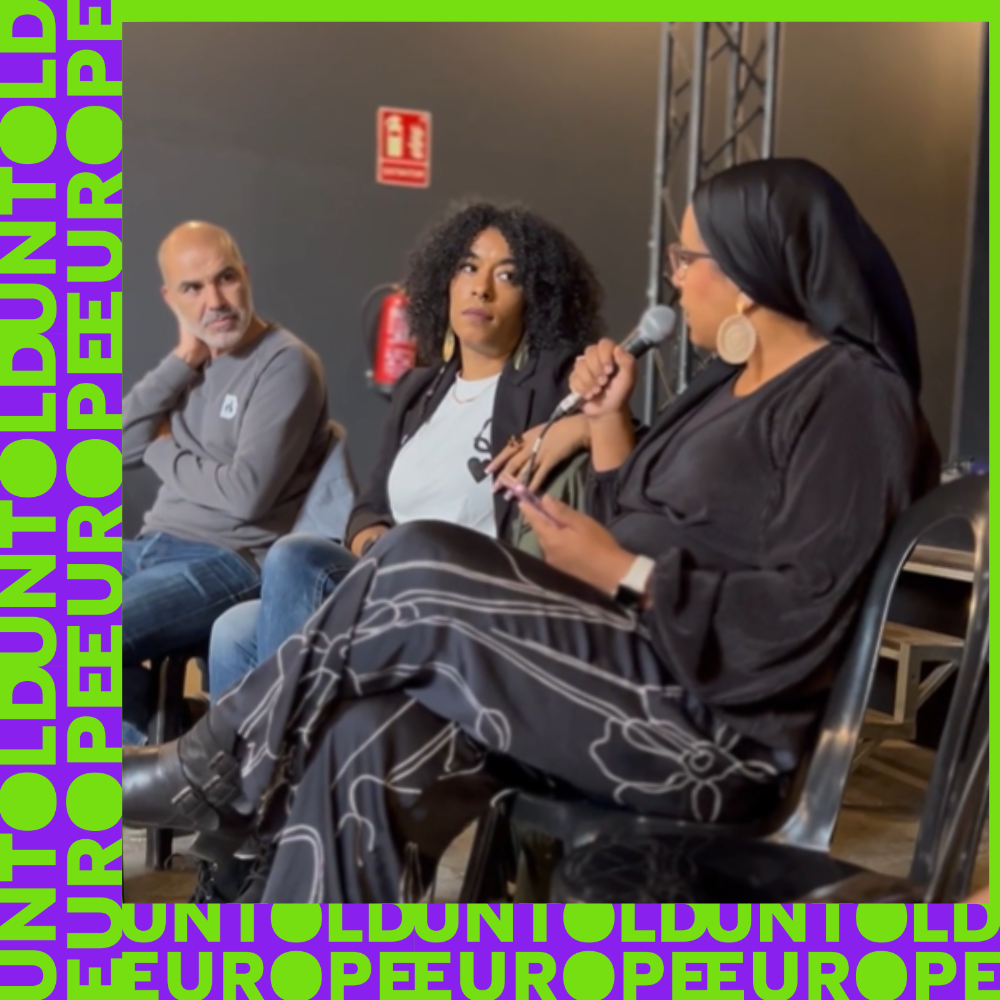
The discussion highlighted the existence of a racial pact shared by both the left and the right, evident in migration policies, borders and episodes of institutional violence such as Tarajal and Melilla, even under self-proclaimed progressive governments. Europe practises race on a daily basis while denying it discursively, and the left often operates out of fear of breaking that pact, aware that, for example, the Immigration Law organises labour exploitation and divides the working class. This lack of political courage prevents the articulation of a clear anti-racist and anti-colonial project in the face of the rise of supremacist imaginaries, such as the discourse of ‘re-emigration’ in countries like the Netherlands.
It was also pointed out how the left has weakened social movements by co-opting leadership, reducing their capacity for criticism and action. In this context, anti-racism needs to formulate strategic questions that allow for challenging hegemonic narratives. It was noted that, without in-depth and contextualised work, anti-racism can reproduce intercultural and “cultural diversity” discourses that function as subtle forms of racism. The central task is to construct a transformative language that places a logic of shared humanity at its centre.
In the case of the left, how do they position themselves in relation to this racial pact? They position themselves in fear. Fear of breaking the racial pact, as this would mean political suicide. They are aware that the Immigration Law divides the working class into the exploited and the super-exploited, allowing for the regulation of wages and working conditions of the working class. It is not ignorance, it is a lack of political courage. Basha Chague
The fourth conversation focused on the externalisation of borders and its impact on countries in the Global South. Specifically, one of the most worrying aspects discussed was how the rise of populism is taking hold not only within the European Union but also in countries with which the European Union has agreements. Although the phenomenon, despite appearing new, has been around for many years, it is only now that it is being openly contemplated by both sides, without the slightest concern for what it means for the rights of migrants and citizens of these countries. Focusing on populism is therefore an urgent task that we must undertake.
Outsourcing borders means extending Europe’s borders and placing the burden of border control on the shoulders of southern countries. Surveillance and control, paying third countries to stop migrants from coming to their countries. This is a contradiction between what the EU says and what it does. Azize Asaring
In addition to the discussions, the documentary The Pickers was screened, exposing the harsh reality of migrant workers in the countryside throughout the European Union. We were able to hear first hand accounts from the film’s main protagonists, who spoke about the ongoing violation of labour rights to which they are subjected. After watching the documentary, we had a conversation with Seydou Diop from ASNUCI, who put the entire business system that profits from migrant labor at a loss, a system that is sustained by immigration and border laws.
For those who attend to this Event, thank you for the participation and courage in tackling difficult issues, and we hope to see them again at future UNTOLD events.