Knowledge

Filter by

Towards Coherent and Human Rights-Based Migration Governance in Europe

Addressing Structural Imbalances in the Light of Colonial Narratives on Migration in Europe

Executive Summary

This policy paper synthesises findings from three thematic case studies examined during the Untold Europe workshop in Brussels on 21 October 2025. Each case examined a different layer of European migration governance: circular labour migration, external migration cooperation, and internal asylum governance. Through comparative analysis, the workshop identified recurring structural patterns in how mobility is managed, how responsibilities are distributed, and how protection standards are implemented.

While each policy field has its own legal and institutional logic, the cases revealed common tensions between management objectives and rights safeguards. This paper consolidates those findings into a coherent policy analysis aimed at supporting more balanced, sustainable, and legally consistent migration governance within and beyond the European Union.

Case Study 1 – Circular Labour Migration and Agricultural Work

The first case study focused on circular migration schemes in the agricultural sector, discussed during the workshop as an example of labour mobility designed to address seasonal workforce shortages. Participants examined how such programmes operate in practice, particularly in Southern Europe, and how recruitment, residence status, and working conditions are structured. The discussion highlighted that while these schemes offer employment opportunities and address labour market needs, they frequently rely on highly temporary statuses and employer-dependent residence arrangements.

Workshop participants concluded that this structural design can limit workers’ bargaining power, restrict mobility between employers, and create differentiated access to social and labour rights. The case demonstrated how labour migration governance can unintentionally contribute to segmented labour markets if mobility, equal treatment, and access to remedies are not adequately safeguarded. These findings informed the broader policy recommendation that labour migration frameworks should integrate stronger rights protections alongside economic objectives.

Case Study 2 – External Migration Cooperation and Responsibility Distribution

The second case study addressed EU cooperation with third countries on migration management, examined through the lens of recent partnership frameworks discussed at the workshop. Participants analysed how operational responsibilities related to border control and containment are shared between the EU and partner countries. The discussion focused on governance capacity, accountability mechanisms, and the alignment between financial support and protection standards.

The workshop concluded that external cooperation can contribute to migration management objectives but also creates potential responsibility gaps where monitoring, legal safeguards, and access to remedies are limited. Participants emphasised that policy effectiveness depends not only on reducing movements but also on ensuring that protection outcomes are verifiable and consistent with international and EU legal standards. These conclusions shaped the recommendation that external partnerships should be systematically linked to transparency, independent monitoring, and rights-based benchmarks.

Case Study 3 – Internal EU Asylum Governance and Solidarity Mechanisms

The third case study examined recent developments in EU asylum governance, with particular attention to solidarity mechanisms, procedural harmonisation, and the treatment of vulnerable applicants. Workshop participants explored how reforms aim to improve system functionality and coordination among Member States while managing pressures on national systems.

Discussions highlighted that while solidarity tools are intended to distribute responsibilities more evenly, protection standards and reception conditions remain unevenly implemented across the Union. Participants noted that procedural obligations for asylum seekers are increasingly detailed, whereas enforcement of Member State compliance with protection standards can be inconsistent. The workshop, therefore, concluded that solidarity and system functionality must be closely linked to enforceable protection guarantees to ensure long-term system credibility and legal coherence.

Integrated Analysis

Across the three cases, the workshop identified a shared governance pattern: migration is frequently addressed through instruments designed to manage distribution, containment, and procedural compliance. By contrast, mechanisms ensuring participation, equal treatment, and consistent protection standards often develop more slowly or unevenly.

The comparative discussion showed that these dynamics are not confined to one policy field but arise across labour migration, external cooperation, and asylum governance. This insight underpins the paper’s central argument: strengthening accountability, legal clarity, and rights consistency across all migration governance domains is essential for effective and sustainable policy.

Policy Directions

Building on the workshop conclusions, the paper proposes policy directions aimed at better aligning management tools with protection standards. Strengthened monitoring and accountability mechanisms, clearer procedural standards, and improved access to remedies are key elements across all governance areas.

In labour migration, ensuring mobility rights and equal treatment would support fair labour market outcomes. In external cooperation, linking funding and partnerships to verifiable protection benchmarks would reduce legal and reputational risks. Within the EU, solidarity mechanisms should be directly tied to minimum protection standards to ensure that responsibility-sharing also guarantees rights consistency.

The workshop-based comparative approach demonstrates that structural imbalances between control-oriented measures and protection safeguards can emerge across different migration governance fields. Addressing these imbalances does not require abandoning management objectives but integrating them more closely with legal certainty, accountability, and protection standards.

A more coherent and rights-consistent migration governance framework would strengthen the EU’s capacity to manage migration sustainably and credibly while upholding its legal and normative commitments.
UNTOLD Europe Workshop – Case Study Session Report (21 October 2025)

Case Study Session Overview

The case study session, held during the UNTOLD Europe Workshop on Migration Narratives on 21 October 2025 in Brussels, constituted a central interactive component of the workshop and was designed to translate the workshop’s conceptual discussions on colonial legacies, migration narratives, gender, and human rights into concrete and comparative analysis.

Participants were divided into four small working groups of 5-person, each focusing on a distinct case reflecting contemporary forms of migration governance and externalisation in the Euro-Mediterranean context. The session combined collective analysis, critical reflection, and creative reframing, encouraging participants to interrogate how historical power asymmetries and colonial continuities remain embedded in current migration frameworks.

Objectives of the Case Study Session

The case study session pursued three interrelated objectives:
– To analyse how colonial legacies, racialised hierarchies, and unequal power relations shape present-day migration policies and narratives;
– To examine the implications of these frameworks for labour rights, gender equality, and human rights;
– To encourage participants to reframe dominant migration narratives and develop alternative, rights-based perspectives.

Structure and Methodology

The session was conducted in two stages. In the first stage, groups familiarised themselves with their assigned case and identified key narrative frames, policy mechanisms, and governance logics. In the second stage, groups shifted from analysis to reflection and creative reframing. Each group concluded by formulating key observations and insights, which were later shared in the closing plenary.

Case Study Groups and Thematic Focus

Group 1: Labour Migration from Egypt and Bangladesh to Greece

This group examined labour migration pathways from Egypt and Bangladesh to Greece, focusing on temporary and irregular labour regimes in sectors such as agriculture and construction. Discussions highlighted how colonial and postcolonial labour hierarchies shape recruitment practices, legal precarity, and working conditions. Particular attention was paid to racialisation, the commodification of migrant labour, and limited access to rights and legal protection.

Group 2: The EU Migration Pact

This group analysed the EU Migration Pact as a framework reshaping migration governance across the European Union. Discussions focused on securitisation, border procedures, and differentiated treatment of migrants, as well as the broader narrative implications of managing migration primarily through control-oriented approaches.

Group 3: The EU–Tunisia Memorandum of Understanding

This group explored the EU–Tunisia Memorandum of Understanding as an example of migration externalisation. The analysis centred on asymmetrical power relations, the delegation of border management, and the implications for accountability and human rights protection.

Group 4: Spain–Morocco Circular Migration

This group focused on Spain–Morocco circular migration schemes, particularly in seasonal agricultural labour. Discussions examined how controlled mobility regimes reproduce colonial patterns of labour extraction, gendered recruitment, and structural dependency.

Conclusion

Across all four case studies, participants identified recurring themes, including the persistence of colonial and racialised hierarchies, the prioritisation of labour and security concerns over rights, and the gendered dimensions of migration governance. The session enabled participants to connect theoretical discussions with concrete cases and to reflect collectively on alternative narratives grounded in dignity and inclusion.

The case study session underscored the value of participatory and comparative analysis in understanding contemporary migration dynamics. By engaging with diverse cases, participants contributed to a shared reflection on how migration narratives can be critically examined and reimagined beyond colonial continuities.

For a new Mediterranean Pact

Today, the Mediterranean is a region marked by multiple overlapping crises: persistent forced displacement, protracted conflicts, wars, occupation and genocide, growing inequalities, shrinking civic space, and a climate emergency that, year after year, worsens the lives of millions of people. The Mediterranean Sea is also one of the most dangerous migration routes in the world, where human tragedies occur every day as a direct consequence of political decisions taken at European level.

On the eve of the launch of the EU Pact for the Mediterranean, a group of civil society organizations are contributing to the public conversation with a perspective that seeks to challenge the course of Euro-Mediterranean relations to date, emphasizing the right to human mobility, climate justice, the protection of civic space and defenders, and the reduction of inequalities. In short, we are calling for a comprehensive rethinking of Mediterranean cooperation.

“The gross inequalities across the region already threaten to tear apart the fabric of our societies. As the inequality gap widens into a chasm, countries grapple with complex challenges of conflict, the climate crisis, and displacement.

“A just Mediterranean cannot be built unless rights are placed at the centre. Nor can it be built while Israel’s relentless violations of International Law continue with impunity, affecting people who are already enduring severe inequality, instability, and violence.

“There must be a new vision that is rooted in dignity, justice, and the protection of every human life.” Sally Abi Khalil, Oxfam MENA Regional Director

“Real stability in the Mediterranean cannot come from investment and security cooperation alone. It requires open societies, accountable governments, and space for citizens and civil society to participate freely. Human mobility in the region must respect the same principles. There is a risk that the Pact for the Mediterranean could reverse the Barcelona trajectory – not only reinforcing the status quo but also empowering authoritarian and anti-human rights trends in the Southern Mediterranean.” Sara Prestianni, Advocacy Director at EuroMed Rights

This initiative has been carefully crafted by Oxfam Intermón colleagues from the Oxfam MENA platform, partner organizations in MENA and on this side of the Mediterranean, in coordination with the OI office in Brussels, and with the indispensable communications support of the Global Strategic Communications Council (GSCC), which has accompanied us throughout the process. We also had the opportunity to contribute to the discussion with activists in the field of migration and anti-racism as part of the Courageous Conversations in Barcelona, part of this UNTOLD project.

Below, we share the following joint manifesto so that you can promote and spread the word right now.

English manifesto

Spanish manifesto

Arabic manifesto

Share this information.

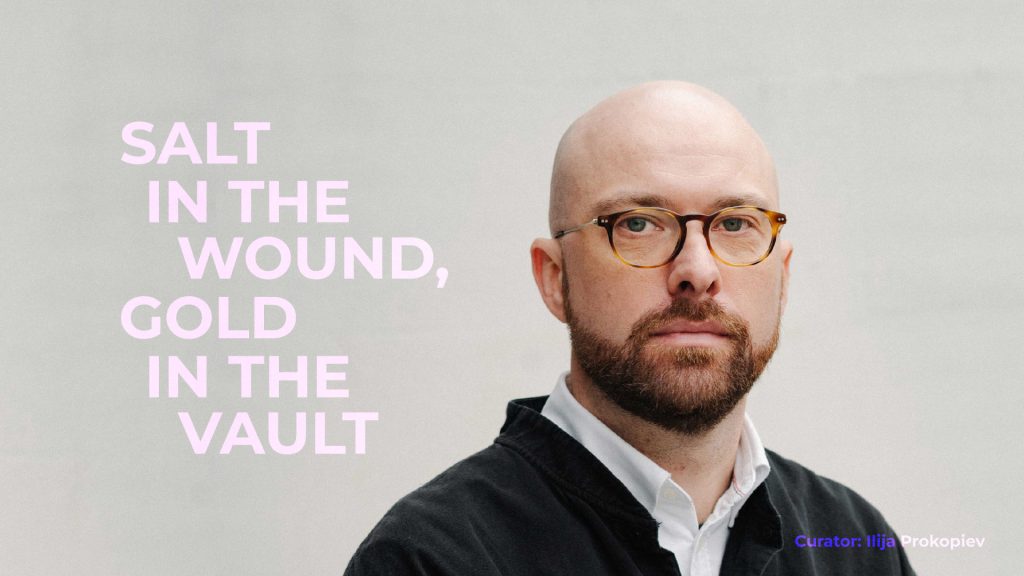
Exhibition “Salt in the Wound, Gold in the Vault”

curator: Ilija Prokopiev

One of the enduring dangers in addressing complex problems is the tendency to divide situations into binary oppositions, where one side is deemed right and the other wrong. This dualistic framework, as reflected in the name of the exhibition, is a convenient tool for those who hold power, the privileged, the oppressors. It simplifies reality into categories of good and evil, friend and enemy. Such divisions are embedded in the language of power because they make it easier to assign blame rather than confront systemic injustice. Colonialism and its violent legacies rest upon these artificial separations: the “civilized” and “educated” West versus the “tribal” and “primitive” Third World. This compartmentalized worldview, as Frantz Fanon describes it in his seminal book The Wretched of the Earth, has shaped the histories of domination, creating a constant loop in the world’s movement, where there will always be someone to oppress and someone to be oppressed. Therefore, Fanon points out that no matter how violent the revolution against colonial rule is, the struggle does not end with it. Liberation is a long process of persistence. He cautions against the naïve belief that decolonization can be realized only through revolution or the goodwill of the colonizers. Instead, he insists that this monumental task, which involves reintroducing humanity to itself in its totality, requires the active participation of the populations on all sides. These populations must awaken, cast off complacency, and abandon the “Sleeping Beauty” posture that has allowed them to tacitly align with colonial power. This process should discredit the imposed Western ideals of the cult of the individual, the pursuit of Enlightenment, and the reverence for Beauty, exposing them as hollow, reduced to fragile ornaments with no relevance to the urgent, collective fight for freedom and justice, and forever changing the dualistic view on the world.

The exhibition Salt in the Wound, Gold in the Vault engages critically with the world we continue to inhabit, a world still deeply marked by colonial legacies that still shape political, economic, and cultural realities today. At the same time, the exhibition gestures toward processes of liberation and transformation. It brings together the artistic voices of Oscar Cueto, Helena Wittmann, Fehras Publishing Practices, Davide Degano and Helena Tahir all coming from or beyond Europe, to explore moments of mutual reconfiguration through artistic practices as a process of liberation. Through their art practices, they present a dialogue between two critical perspectives: artists who confront colonial histories through personal or inherited experience, and artists who, while not direct inheritors of colonial trauma, engage deeply with its cultural, political, and moral weight. Their works transcend geographical and historical boundaries, spanning different artistic media and methodologies, as they interrogate the complex and often uncomfortable relationships between Europe’s colonial past and its contemporary realities.

Fehras Publishing Practices presents their process-based art installation, Wheat Flower, a work that explores the conditions of cultural workers and cultural production, encouraging collective exploration through the lens of “labor.” It draws on the legacies of practitioners who situated their work within broader struggles for anti-colonial liberation. The title, referencing the wheat harvest season, invites us to reimagine cultural work as a shared act of cultivation. 

Set within the chambers of the Belvedere Bastion, once a key element of Koper’s defense system, Wheat Flower gains a layer of meaning through the dialogue between historical defense strategies and contemporary acts of cultural resilience. By engaging local communities throughout the installation process and through accompanying workshops, the collective creates a temporary space of resistance, nurturing solidarity and camaraderie. In doing so, it offers a renewed reading of resistance, not as an act of aggression, but as a spontaneous, connective force that unites communities in the face of dominant imperial structures. Evolving throughout the exhibition as a generative library, Wheat Flower reflects on cultural production as both a site of resistance and a space for collective learning.

The juxtaposition of photographs and video archival material from Davide Degano’s project Romanzo Meticcio explores photography as a medium that shapes histories, influences politics, and constructs narratives. Historically, also used to legitimize colonial policies and racial hierarchies, photography functioned as a performative tool of exclusion. Degano critically responds to this legacy by employing photography and video as instruments of truth-telling, confronting Italy’s silenced colonial and oppressive past.

Interweaving personal and collective histories, Degano interrogates dominant narratives of Italian identity. Born in Sicily and raised in Friuli to Colombian and Slovenian grandmothers, he works from a position of liminality, blending lived experience with critical reflection. His photographs and videos resist linear storytelling, inviting open interpretation. By foregrounding marginalized perspectives, Degano destabilizes fixed notions of identity, offering a more nuanced and complex understanding of Italy’s cultural fabric.

Essay on Memory by Oscar Cueto is an animated film essay presented alongside an installation of objects and a large-scale drawing. Conceived as a stage for possible cultural futures, the work unfolds through the narration of six interwoven stories. Integrating personal memories with ambiguous and erotic scenes, it proposes an alternative archive that challenges dominant art historical narratives and the ways histories are constructed and remembered.

In Cueto’s practice, culture is understood as inherently mobile, capable of moving and transforming beyond institutional structures. In his works, to sustain culture, it must remain embedded in people’s experiences and memories rather than confined within exclusive institutional frameworks. Here, the survival of culture depends on living memory, not on distant mechanisms of preservation.

Migration is a central theme in Cueto’s work, conceived not only as a metaphor but also as a tangible movement of people, ideas, and artworks, serving as a strategy of resistance against the historical processes of institutionalization and museification rooted in imperial and colonial histories. By linking past and present, Cueto reveals how historical silences continue to shape our ways of remembering and imagining, opening space for alternative futures to emerge.

The Last Sector by Helena Tahir is a profoundly personal and long-term research project that explores themes of migration, displacement, and inherited memory through the lens of her Iraqi heritage. Initiated in 2023, the project began with her first visit to Iraq, where she reconnected with her paternal family. During this pivotal journey, Tahir began gathering archival materials and creating her own photographic documentation, laying the foundation for a body of work that merges intimate experience with broader socio-political narratives.

The title The Last Sector refers specifically to Sector 38 of Sadr City in Baghdad, where her father’s family resides. Yet in Tahir’s work, this precise geographic location transforms into a broader metaphor, a symbolic meeting point for those with shared histories of forced migration, political exile, and the lingering effects of colonial legacies. It becomes a space of empathy and quiet solidarity.

Tahir’s latest body of work continues this inquiry through a new sculptural installation. Comprising a series of suspended reliefs, each object is meticulously crafted using laser-cutting and engraving techniques. The reliefs are formed by layering materials engraved at different layers, textures, and motifs. Hung at different heights and scales, they create an immersive and dynamic composition within the exhibition space. The installation evokes a sacred atmosphere, an encounter with the hidden and the unspoken. It is a space where silence speaks, and where what remains unsaid is rendered both visible and deeply felt.

With the screening of Helena Wittmann’s film Human Flowers of Flesh, the exhibition expands its inquiry into additional dimensions, engaging directly with the intertwined notions of time and space. Through her cinematic work, Wittmann positions the audience at the very forefront of European colonialism, the Mediterranean Sea, inviting us to navigate its historical and political currents.

The film follows Ida, the central protagonist, who lives aboard a ship with a crew of five men. While in Marseille, her curiosity is piqued by the enigmatic, male-dominated world of the French Foreign Legion. Determined to trace its legacy across the Mediterranean, Ida and her crew set sail via Corsica toward Algeria, home to the Legion’s historic headquarters. As their journey unfolds, familiar boundaries dissolve, and life at sea fosters a unique sense of shared understanding. As Małgorzata Sadowska notes, fluidity lies at the heart of Helena Wittmann’s film, manifested through the movement of people, ideas, and the sea itself. Guided by a woman, the journey from Marseille to Sidi Bel Abbès traces colonial routes, yet opposes their legacy by assembling a poetic, nomadic crew that drifts between land and water, past and present, evoking a world without borders. 

Building on these diverse artistic trajectories, the exhibition, which spans multiple unconventional sites in Koper, actively engages both audiences and local communities through its varied artistic approaches. By critically examining how colonial legacies are remembered, resisted, and reimagined, the participating artists employ anti-racist, feminist, and decolonial methodologies to unsettle dominant historical narratives. Their practices create spaces for critical reflection and propose alternative modes of inhabiting the present, opening pathways toward the emergence of new and plural histories.